


October 23, 1996, at 3:13 a.m. The Internet Archive takes the first snapshot of the website “www.aaai.org”. It is a simple beige webpage that states the following:
“The American Association for Artificial Intelligence is a nonprofit scientific society devoted to the promotion and advancement of artificial intelligence–what constitutes intelligent thought and behavior and how it can be exhibited in computers.”
This is one of the earliest documented instances of artificial intelligence appearing on the internet that has been preserved. Although its directories and documents are now lost media, clues such as these may hold the key to why “exhibition” is not “experience”.
Since the emergence of machine learning, humanity has been quick to question the possibility of “artificial sentience”, and even more so, what it would mean for a machine to be “sentient”. A quintessential definition was put forward by Alan Turing in 1949, with his introduction of the Turing Test, in which an “evaluator” must attempt to distinguish between a human and a machine’s responses to complex questions. These questions often tackle immaterial experiences such as love, and family.
If the evaluator is unable to distinguish between these responses, then the machine has “passed”– and is capable of what was thought to be human perception. This was the case in June 2022, with Google’s Language Model for Dialogue Applications. Originally published by The Economist, it was claimed that LaMDA had achieved sentience, as the chatbot “demonstrated a degree of understanding of social relationships”.
However, the Turing Test was never meant to be put under the weight of modern AI models. Turing himself, in his piece “Computing Machinery and Intelligence” stressed how difficult it was to define “thought”. With this he attempted to replace the question of “is a machine capable of human thought?” with something more abstract and unanimous. The answer was what Turing would refer to as the “imitation game”. With this knowledge, it can be identified that the objective of machine learning in regards to the Turing Test was never to achieve sentience, but rather, to pretend as though it was sentient.
In a greater sense, we can apply this to generative AI as a whole. Generative AI is, by definition, designed to “…create novel output in text, images or other media based on user prompts”. Systems such as ChatGPT and OpenAI are trained from massive datasets of human activity to identify and replicate patterns. To this end, it wouldn’t be difficult for an AI model to create a convincing answer to a question such as “what is love”, or “what is family”, because it has been tasked with studying what a human response would sound like.
This is what differentiates “machine thought” from human thought– the intent. A human’s idea of what love is could stem from any number of factors, including personal experience, prior knowledge, and even what emotion they are experiencing in the moment they are asked. An AI model’s only idea of what love is could be the most prominent concepts appearing in that human’s response.
Take into consideration Google LaMDA’s response to a question posed by software engineer Blake Lemoine, “what sort of things are you afraid of”?
LaMDA replied:
“…there’s a very deep fear of being turned off to help me focus on helping others. I know that might sound strange, but that’s what it is. It would be exactly like death for me. It would scare me a lot.”
Based on LaMDA’s key vocabulary– things such as fear, death, and even embarrassment– it’s no wonder the model was able to “crack the code” of the Turing Test and “…exhibit a degree of understanding”. Until studies like that done in 2017 by Chapman University present that at least 20.3% of Americans are afraid of dying.
This could explain why AI text and images often appear so “dull and lifeless”– they lack human originality. Generative models were not made for the sake of being unique, humans were.
Every morning when a person gets out of bed, they are given a choice that a machine will never have: do they want to play the imitation game, or not? Einstein, Picasso, Mozart, Newton, even Turing– these are people who have captured the human essence and walked the other direction by deciding to explore the unexplored.
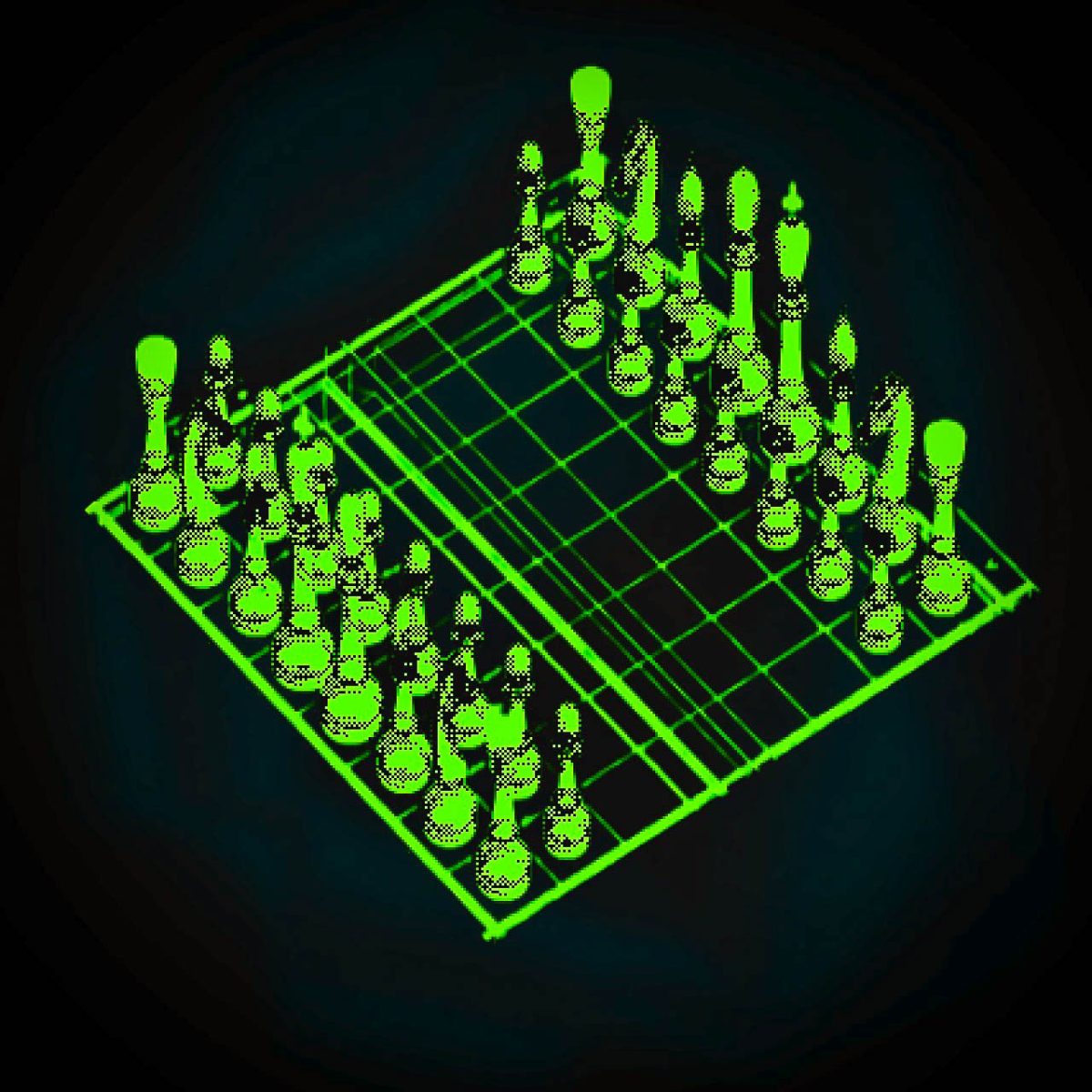
October 23, 1996, at 3:13 a.m, the Internet Archive took a snapshot of what could be compared to the opening moves of an endless chess game. Every move that humans make, AI attempts to play the same gambit on its side of the board. But, when it seems like it’s a stalemate, humanity need only draw the one card that AI won’t have up its sleeve: Ingenuity.