

As conversations continue to revolve around representation, equality, and overall national identity across America, Black History inevitably writes significant portions of the nation’s history. However, even with the annual attention, generations of African American pioneers shaping all avenues of American history gets diluted to small paragraphs in a textbook— then swiftly closes once the bell rings. Performative Diversity, Equity, and Inclusion (DEI) programs advertising themselves to expand inclusivity and the threshold of equity, yet discrimination within workplaces continues to advance exponentially. Socially, black excellence and pride becomes a radicalized ideology, and a waft of ignorance fills leaders and pioneers have imprinted on American soil.
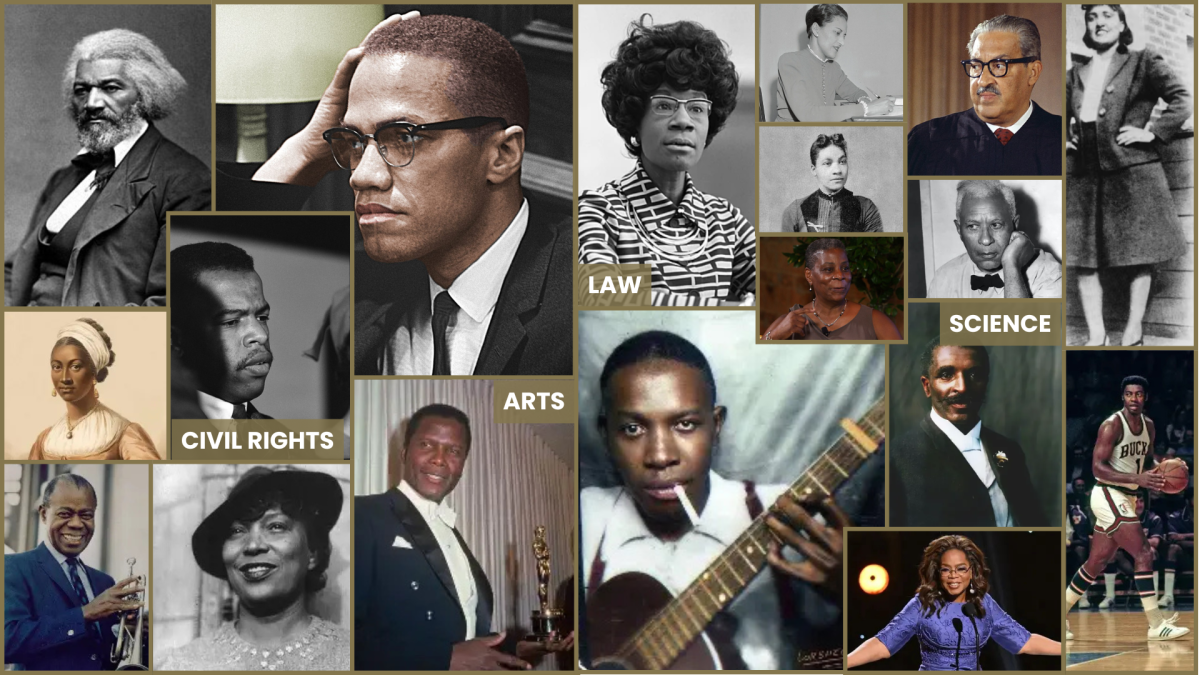
The longstanding struggle for the progress seen in today’s history deteriorates in meaning, so long as it only exists within the confines of social media posts, reposting on February 1st then forgotten soon after. Figures that have paved way for notorious abolitionist movements such as Harriet Tubman, Fredrick Douglass, Malcom X, and John Lewis come to mind, however their stories quickly diminish the courage it takes to stand up to an entire political system that exploits and corrupts them to commodities shackled to industrialist and corporate projects. Malcom X warned collectivist societies in normalizing these rhetorics.
“A race of people is like an individual man; until it uses its own talent, takes pride in its own history, expresses its own culture, affirms its own selfhood, it can never fulfill itself” said Malcom X.
However Black history is never constrained within the confines of the abolitionist movement. Pioneers of law and politics are always best noted within African American history, as it swiftly followed much of abolitionist sentiments.
Individuals such as Thurgood Marshall, Shirley Chisholm, and Jane Bolin to name a few, contributed shifts in the industry.
“You don’t make progress by standing on the sidelines, whimpering and complaining. You make progress by implementing ideas”, said Chisholm. “I’d like them to say that Shirley Chisholm had guts. That’s how I’d like to be remembered”
She was remembered by just that.
Social and political systems of thought undoubtedly hold true for a marginalized population that experienced racism, oppression, and various manifestations of discrimination. It’s important however, to not depict African American individuals as a helpless collective with their sole objective to escape generational traumas. For marginalized groups alike, traumas such as these do not define them, and despite the attempts to refute and exploit their findings, African American individuals facilitated incredible advancement within the scientific and medical field. George Washington Carver, Henrietta Lacks, Garett Morgan, and Dr. Rebecca Crumpler is only to name a few. Dr. Rebecca Lee Crumpler spoke upon being the first African-American female doctor of medicine, and the experiences alongside with the label.
“During my stay there, nearly every hour was improved in that sphere of labor. The last quarter of the year 1866, I was enabled… to have access each day to a very large number of the indigent, and others of different classes, in a population of over 30,000 colored” said Crumpler.
Last but certainly not least, the arts, literature, and overall cultural implications that African Americans have contributed within American culture. From the Harlem Renaissance and beyond, art is inherently political, and nonetheless powerfully represented by Black empowerment. Individuals such as Phillis Wheatley, Zora Neale Hurston, Sidney Poitier, and Louis Armstrong are only a few.
“If I’m remembered for having done a few good things, and if my presence here has sparked some good energies, that’s plenty,” said Sidney Poitier.
The longstanding struggle for the progress seen in today’s history deteriorates in meaning as it only exists within the confines of social media posts, reposting on February 1st then forgotten soon after. We often forget however, that prejudice and discrimination not only harms marginalized groups significantly, yet also backfires onto the oppressive system enabled for decades. Without variety in culture, the daily living of an average American will soon become bland in sentiment. As Martin Luther King Jr. best puts it…
“We must accept finite disappointment, but never lose infinite hope,” said MLK. “Life’s most persistent and urgent question is, ‘What are you doing for others?'”